






















As we saw in the CVTAG Meeting Minutes thread, the “experts” had known about safety signals from other countries that showed an increased rate of Myocarditis in males under 30 after receiving a second dose of mRNA vaccine, and that younger people were not at risk from severe outcomes due to Covid infection since June 2021.
CVTAG’s position was that due to the low risk from Covid, and the increased rate of myocarditis and pericarditis in people under 18, one dose should be sufficient for this group to be considered “Fully-Vaccinated” for mandate purposes.
Yet, the decision was eventually made to mandate these younger people to take two doses of the vaccine.
*UPDATE* In May 2021 (presumably, the OIA says May 2017), a Medsafe memo titled “Comirnaty and potential myocarditis” mentions the risk exists, but specifies:
Rare cases of myocarditis have been reported after vaccination with Covid-19 mRNA vaccines, such as Comirnaty,
and to a much lesser extent with Vaxevria. Seems to be more young people affected and more males, although
cases have been seen in all ages and also involving females. The time to event is unclear. The myocarditis has
often been mild and self-limited but in some cases the event has been more severe. Causality between the vaccine
and myocarditis has not been concluded.
Interestingly the next part is partially redacted.
International regulators, as well as Medsafe, are currently investigating the signal, and more information will
hopefully be available soon. The company evaluation resulted in a REDACTEDPARTHERE
The signal has internationally not led to any restrictions of the use of Comirnaty or other Covid
19 vaccines in NZ or internationally.
Now let’s take a look at some of the CVTAG memos (Wayback Link).
In the 24 June 2021 memo “Decision to use the Pfizer mRNA COVID-19 vaccine for children aged 12 -15
years:”: (Wayback Link)


55,280 people aged 12-29 had a second dose administered.
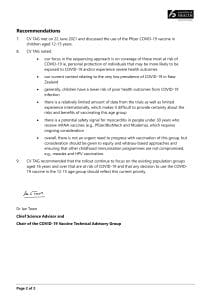
• generally, children have a lower risk of poor health outcomes from COVID-19
infection
• there is a relatively limited amount of data from the trials as well as limited
experience internationally, which makes it difficult to provide certainty about the
risks and benefits of vaccinating this age group
• there is a potential safety signal for myocarditis in people under 30 years who
receive mRNA vaccines (e.g., Pfizer/BioNtech and Moderna), which requires
ongoing consideration
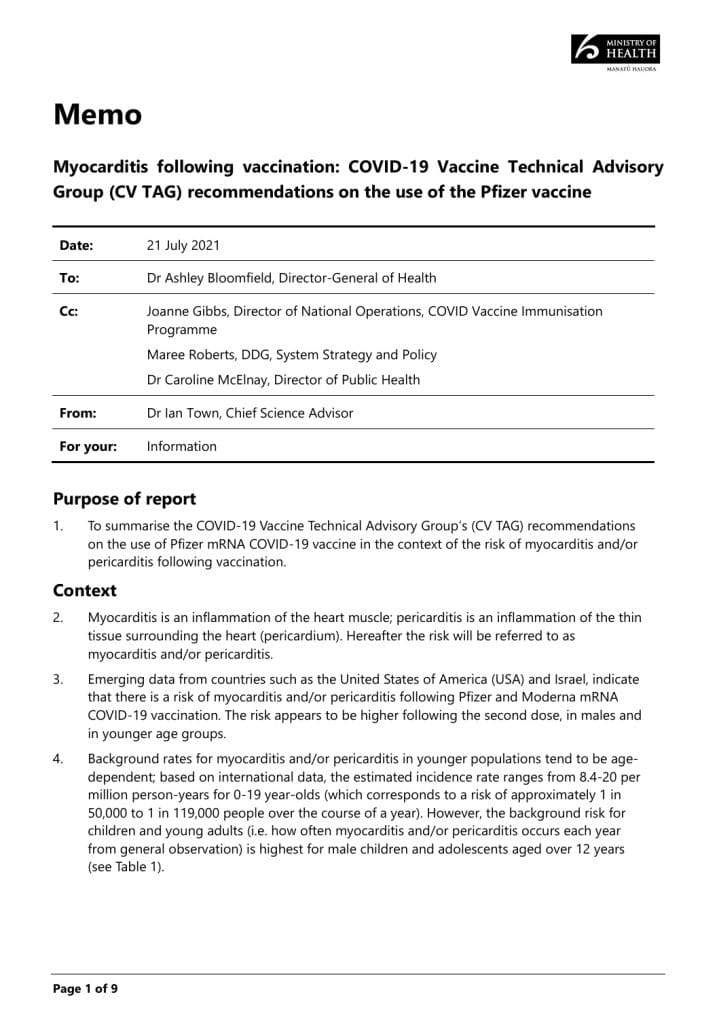
On 21 July 2021, a memo titled “Myocarditis following vaccination: COVID-19 Vaccine Technical Advisory
Group (CV TAG) recommendations on the use of the Pfizer vaccine” (Wayback Link) was sent to Doctor Ashley Bloomfield.
At that stage there had been 70,135 second doses administered to the 12-29 age group.
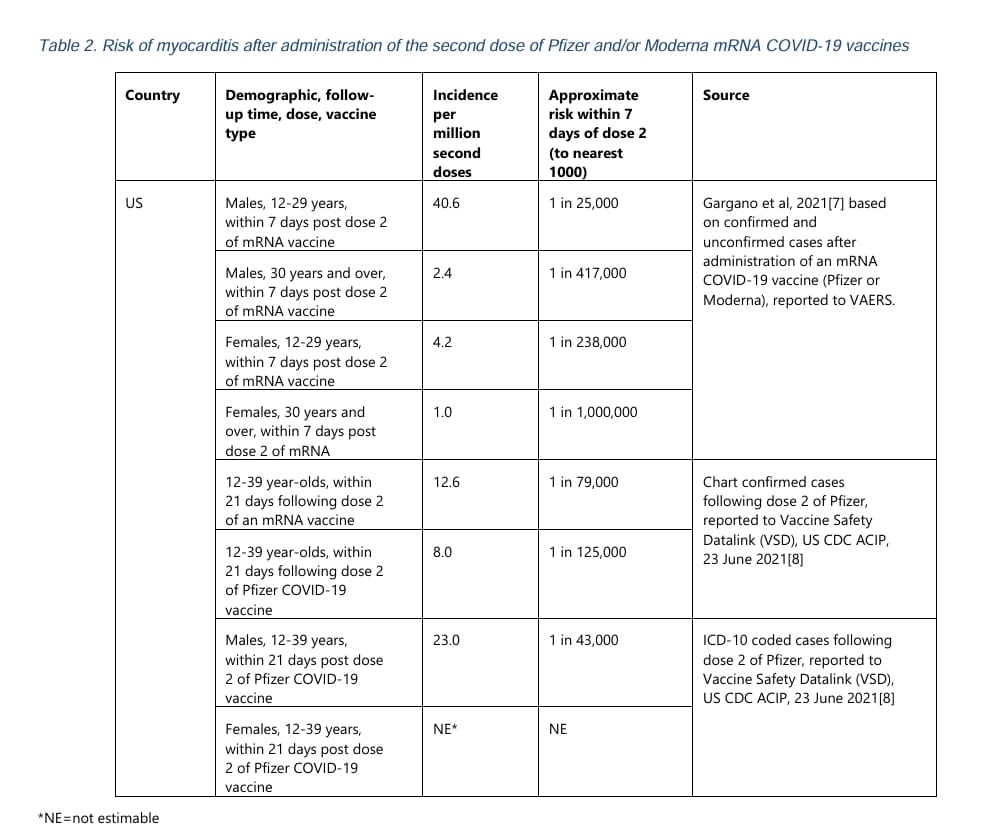
It contained a table showing the rates of Myocarditis following a second dose, these were considerably higher (17x) in males aged under 30 (40.6 per million for under 30s vs 2.4 per million over 30), with a lower, but still significant 4.2x the rate for females under 30 vs females over 30 (4.2 vs 1.0 cases per million).
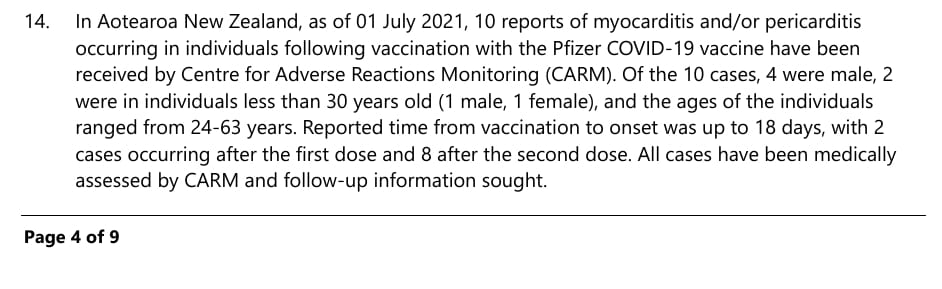
At that stage there had been 10 reports of Myocarditis in NZ following vaccination with Comirnaty. 8 were after the second dose.
There’s a lot of missing Memos, through August 2021 mainly, that I am looking for.
One on the 17th of August mentions removing wording relating to “increasing the time between doses to reduce the myocarditis risk”
In November 2021, CVTAG was approached for advice on how to define “fully-vaccinated” within NZ.
Around 854,645 people aged 12-29 had taken their second dose by this date.
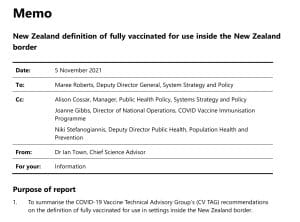
In the 5 November 2021 Memo to Maree Roberts, Deputy Director General, System Strategy and Policy:
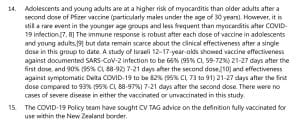
Their advice included the following:
Adolescents and young adults are at a higher risk of myocarditis than older adults after a
second dose of Pfizer vaccine (particularly males under the age of 30 years). However, it is
still a rare event in the younger age groups and less frequent than myocarditis after COVID
19 infection.[7, 8] The immune response is robust after each dose of vaccine in adolescents
and young adults,[9] but data remain scarce about the clinical effectiveness after a single
dose in this group to date. A study of Israeli 12–17-year-olds showed vaccine effectiveness
against documented SARS-CoV-2 infection to be 66% (95% CI, 59-72%) 21-27 days after the
first dose, and 90% (95% CI, 88-92) 7-21 days after the second dose,[10] and effectiveness
against symptomatic Delta COVID-19 to be 82% (95% CI, 73 to 91) 21-27 days after the first
dose compared to 93% (95% CI, 88-97%) 7-21 days after the second dose. There were no
cases of severe disease in either the vaccinated or unvaccinated in this study.
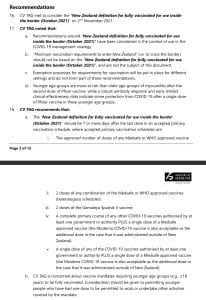
Younger age groups are more at risk than older age groups of myocarditis after the
second dose of Pfizer vaccine, while a robust antibody response and early limited
clinical effectiveness data indicate some protection from COVID-19 after a single dose
of Pfizer vaccine in these younger age groups.
b. CV TAG is concerned about vaccine mandates requiring younger age groups (e.g., ≤18
years) to be fully vaccinated. Consideration should be given to permitting younger
people who have had one dose to be permitted to work or undertake other activities
covered by the mandate.
At some point in between that advice being given, and the actual definition being operationalised, the decision was made to make the course for the under-18s two doses. Not one dose because of Myocarditis risk, but two.
CVTAG then clarified their position, and their concerns on December 9 2021. (978,430 people aged 12-29 had taken a second dose).
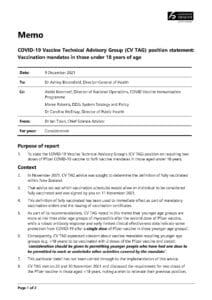
As part of its recommendations, CV TAG noted in this memo that ‘younger age groups are
more at risk than older age groups of myocarditis after the second dose of Pfizer vaccine,
while a robust antibody response and early limited clinical effectiveness data indicate some
protection from COVID-19 after a single dose of Pfizer vaccine in these younger age groups’.Consequently, CV TAG expressed concern about vaccine mandates requiring younger age
groups (e.g. <18 years) to be vaccinated with 2 doses of the Pfizer vaccine and stated:
‘consideration should be given to permitting younger people who have had one dose to
be permitted to work or undertake other activities covered by the mandate’.
This particular detail has not been carried through to the implementation of this advice.
CV TAG met on 23 and 30 November 2021 and discussed the requirement for two doses of
the Pfizer vaccine in those aged <18 years, noting a wish to reiterate their previous position.9.
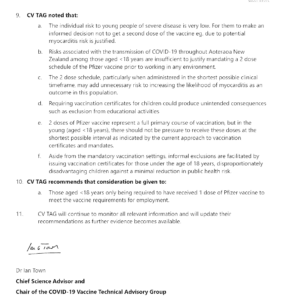
CV TAG noted that:
a. The individual risk to young people of severe disease is very low. For them to make an
informed decision not to get a second dose of the vaccine eg, due to potential
myocarditis risk is justified.b. Risks associated with the transmission of COVID-19 throughout Aoteraoa New
Zealand among those aged <18 years are insufficient to justify mandating a 2 dose
schedule of the Pfizer vaccine prior to working in any environment.c. The 2 dose schedule, particularly when administered in the shortest possible clinical
timeframe, may add unnecessary risk to increasing the likelihood of myocarditis as an
outcome in this population.d. Requiring vaccination certificates for children could produce unintended consequences
such as exclusion from educational activitiese.2 doses of Pfizer vaccine represent a full primary course of vaccination, but in the
young (aged <18 years), there should not be pressure to receive these doses at the
shortest possible interval as indicated by the current approach to vaccination
certificates and mandates.f. Aside from the mandatory vaccination settings, informal exclusions are facilitated by
issuing vaccination certificates for those under the age of 18 years, disproportionately
disadvantaging children against a minimal reduction in public health risk.
10. CV TAG recommends that consideration be given to:Those aged <18 years only being required to have received 1 dose of Pfizer vaccine to
meet the vaccine requirements for employment.
CV TAG will continue to monitor all relevant information and will update their
recommendations as further evidence becomes available.\
(emphasis mine)
In March 2022, a Cabinet Paper was lodged by Chris Hipkins that contained confirmation of the myocarditis risk.
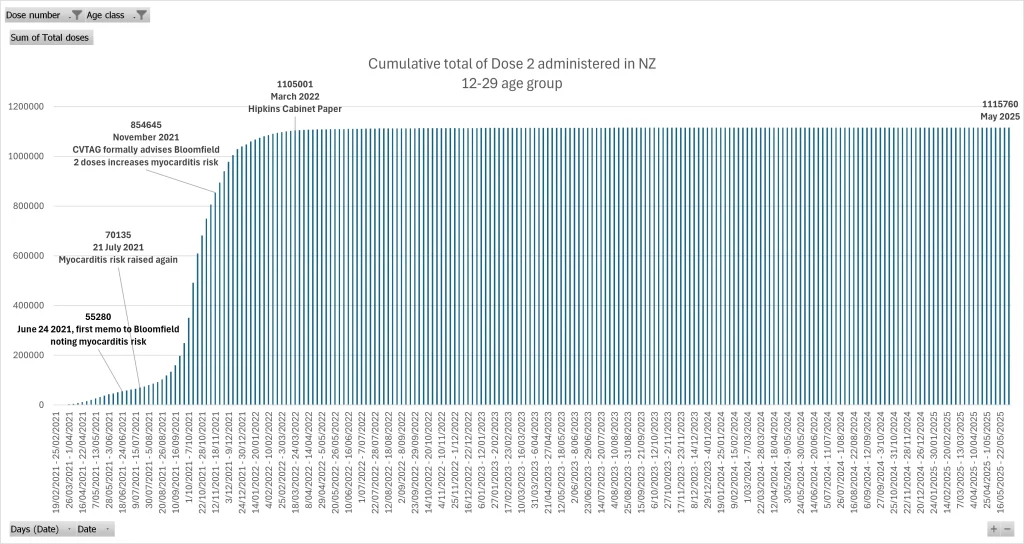
After that? Maybe an OIA will tell us, but young people who were mandated to be fully-vaccinated ended up having to take two doses in spite of the myocarditis risk increase.